ASML Holding N.V. - New York Registry Shares (ASML)
1,759.87
-20.47 (-1.15%)
NASDAQ · Last Trade: Oct 12th, 3:40 PM EDT
ASML supplies the lithography systems chipmakers use and relies on four customers for about 61% of its sales, while TSMC manufactures chips for 534 customers and carries the risk of production concentrated in Taiwan.
Via The Motley Fool · October 12, 2026
The current pace of AI development would not be possible without these semiconductor companies.
Via The Motley Fool · October 12, 2026
Analysts are expecting a big increase in revenue. But this is the other thing I'm looking for.
Via The Motley Fool · October 12, 2026
Chip Equipment Stocks Rally as Quality Growers Lead the Snapbackchartmill.com
Via Chartmill · September 28, 2026
AI simply wouldn't be as effective if it weren't for ASML.
Via The Motley Fool · October 12, 2026

ASML is thinking years ahead of the AI industry, ensuring it remains an industry leader well into the 2030s.
Via The Motley Fool · October 11, 2026
Some of the world's most important artificial intelligence (AI) stocks are noticeably absent from the S&P 500.
Via The Motley Fool · October 10, 2026
ASML controls the machinery behind every advanced chip, while Qualcomm powers the devices that use them, but their risk profiles and valuations tell very different stories.
Via The Motley Fool · October 9, 2026
Both are essential to the AI chip build-out, but they carry very different risk profiles depending on where they sit in the supply chain.
Via The Motley Fool · October 8, 2026
ASML commands chip manufacturing's essential bottleneck with a 29% net margin; Broadcom dominates AI infrastructure with 36% margins and 2.2x faster revenue growth.
Via The Motley Fool · October 7, 2026
Picking winners and losers in the artificial intelligence industry hasn't been easy.
Via The Motley Fool · October 6, 2026
A basket of these five semiconductor stocks should produce strong returns in the coming years.
Via The Motley Fool · October 6, 2026
These companies are essential to the development of every chip sold by Nvidia and AMD.
Via The Motley Fool · October 6, 2026
ASML supplies the machines that advanced chipmaking depends on, while Nvidia generates nearly six times the revenue at close to double the net margin.
Via The Motley Fool · October 6, 2026
The tech giant has a fantastic moat.
Via The Motley Fool · October 5, 2026
Nvidia's close relationship with SK Hynix benefits both companies.
Via The Motley Fool · October 4, 2026
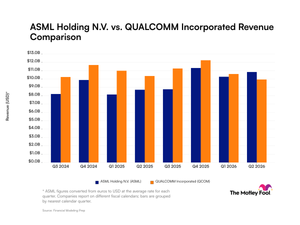
ASML's momentum has flipped the script — it now outpaces Qualcomm in recent quarters after trailing for years, raising questions about whether this inversion will stick.
Via The Motley Fool · October 3, 2026
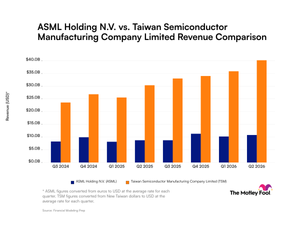
TSMC has consistently outpaced ASML in absolute revenue across eight quarters, but ASML's recent acceleration hints at a shifting competitive dynamic.
Via The Motley Fool · October 3, 2026
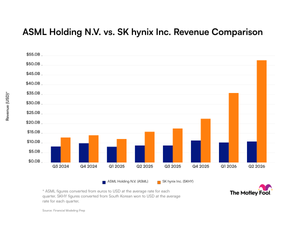
SK Hynix's revenue has accelerated dramatically over eight quarters, while ASML maintained steadier growth — a divergence that reshapes how investors should view these semiconductor-industry heavyweights.
Via The Motley Fool · October 1, 2026
ASML offers unmatched demand visibility, while Applied Materials brings broader AI-driven growth at a lower valuation.
Via The Motley Fool · October 1, 2026
One designs the chips, while the other manufactures the machines that build them. But their valuations tell a starkly different story.
Via The Motley Fool · October 1, 2026
One holds a near-monopoly on advanced chip printing, while the other supplies the broader toolkit. Their financial profiles and risk exposures diverge sharply.

Via The Motley Fool · October 1, 2026
ASML commands the toolmaking monopoly, while SK Hynix dominates memory, but their valuations and risk profiles diverge sharply.

Via The Motley Fool · October 1, 2026
Taiwan Semiconductor Manufacturing and ASML each have their own competitive bulwarks.
Via The Motley Fool · October 1, 2026
ASML commands a near-monopoly on chip-making equipment with a 29% net margin, while Marvell surged 42% in revenue but trades at a steeper valuation.
Via The Motley Fool · September 30, 2026